For drivers, it is crucial to understand the difference between cruise control (CC) and adaptive cruise control (ACC). Although both modes aim to reduce driver fatigue, they have different functions. Next, we will explore the differences between the two modes to help you make an informed decision.
CC (Cruise Control): A simple system that maintains a set speed. Once the vehicle reaches a certain speed, it continues to run at that speed. The vehicle can maintain the preset speed without the driver having to continuously press the accelerator. For example, when driving on the highway at 100 km/h, pressing the cruise control button allows the vehicle to continue at that speed without the need to press the accelerator. Note: Using cruise control in situations where it is not possible to maintain a constant speed can be dangerous. Therefore, do not use cruise control on winding roads or in heavy traffic.
ACC (Adaptive Cruise Control) : A system that automatically adjusts the distance to the vehicle in front based on its speed. It is an upgrade to the traditional cruise control (CC) function and is based on sensor identification technology. It can make the vehicle automatically follow the vehicle in front, maintain the set speed and distance. When the vehicle in front slows down, it automatically reduces the speed. When the vehicle in front accelerates or leaves, it automatically returns to the set speed.
How CC and ACC work
CC (Cruise Control): The principle of cruise control is to compare the vehicle’s speed, which is read by the cruise control unit, with a predefined speed, and then issue a command to adjust the motor’s torque, either increasing or decreasing it, so that the vehicle always maintains the desired speed; therefore, the ECU in the vehicle is the VCU, which controls the cruise control system’s activation and status (activation, deactivation, and proactive acceleration).
ACC (Adaptive Cruise Control) : ACC’s operating mode can achieve speed control (cruise control) and distance control. In the longitudinal control strategy of the ADAS, acceleration and deceleration control must be performed separately. Acceleration control mainly sends the corresponding torque request to the power system, while deceleration control mainly sends the corresponding deceleration request to the braking system.
The difference between CC and ACC
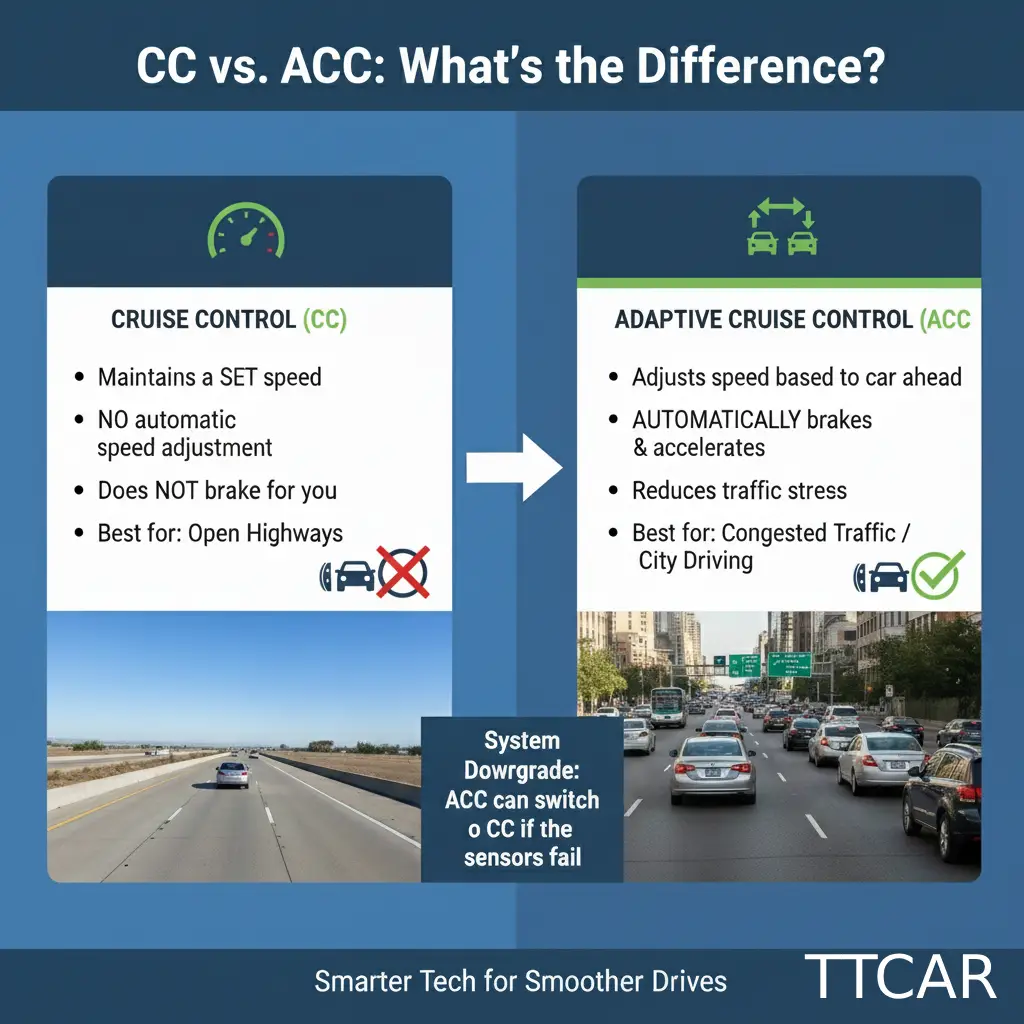
Both Cruise Control (CC) and Adaptive Cruise Control (ACC) share the same foundational features: setting and adjusting a target speed, canceling the system, and basic On/Off functionality. However, they differ significantly in how they handle real-world driving:
Cruise Control (CC)
Standard Cruise Control is designed primarily for open highways with light traffic. It maintains a preset speed but cannot adjust automatically.
- Accelerate Only: The system takes over the accelerator pedal so you can rest your foot, but it does not control the brakes.
- Manual Braking Required: If you need to slow down, you must intervene manually. The vehicle only slows down via engine braking or natural resistance.
- Limitations: On long downhill stretches, the car may exceed your set speed; in many vehicles, this causes the system to automatically disengage.
Adaptive Cruise Control (ACC)
ACC is a much smarter evolution of the technology. It maintains your preset speed while dynamically adjusting based on the distance and speed of the vehicle ahead.
- Comprehensive Control: The Advanced Driver Assistance System (ADAS) manages both the accelerates and the brakes. It effectively “pedals” for you, making it ideal for navigating complex traffic or urban environments.
- Reduced Driver Fatigue: By handling the constant adjustments in stop-and-go traffic, ACC significantly lowers driving stress.
System Downgrading
It is important to note that if the ACC sensors (like radar or cameras) are obstructed or experience a software glitch, the system may automatically downgrade to standard Cruise Control (CC). In this “fail-safe” mode, the vehicle will lose its following capability and will no longer brake automatically.
Which is right for you?
- Choose CC if your driving is almost exclusively on long, empty stretches of highway where speed rarely fluctuates.
- Choose ACC if you frequently deal with heavy traffic or congestion. The intelligent “follow” feature provides a much more comfortable and modern driving experience.